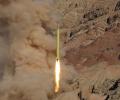
The United States on Thursday put Iran "on notice" for test-firing a ballistic missile and warned of consequences for its "malign actions", signalling a more hardline stance against Tehran that could set the stage for renewed confrontation between the two nations.
A major escalation unfolded in West Asia on Monday after Iran reportedly launched multiple missiles targeting United States military installations in Qatar and Iraq, including Al Udeid Air Base in Qatar -- the largest US military installation in the region, according to a CNN report.

Hours after United States President Donald Trump's claims of an Iran-Israel ceasefire, India on Tuesday said it stands ready to play its part to resolve the situation and insisted on 'dialogue and diplomacy' as the way forward.

India on Friday successfully test-fired an indigenously developed supersonic interceptor missile, which is capable of destroying a hostile ballistic missile, from a test range off the Odisha coast. "At around 12.52 pm, the interceptor hit the target missile successfully at an altitude of about 15 kilometres," said Defence Research and Development Organisation spokesman Ravi Kumar Gupta.

The United States for the first time has successfully tested a ground-based missile defence system which intercepted a simulated incoming missile over the Pacific Ocean.

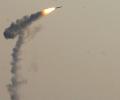
The interceptor, known as Advanced Air Defence missile, was engaged against an electronically prepared target which simulated the trajectory of a hostile ballistic missile.
The indigenously developed ballistic missile defence system will be test fired in August this year, a top defence official said on Thursday.
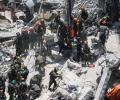
He made the comments while visiting the site of an early morning Iranian missile strike in the city of Bat Yam, close to Tel Aviv.

The US President reiterated his long-held view that Putin wants "ALL of Ukraine, not just a piece of it," and warned that such ambitions could lead to "the downfall of Russia."
In a leap forward to fortify its skies, India successfully test-fired its indigenously developed interceptor missile which destroyed a 'hostile' target ballistic missile, a modified Prithvi, at an altitude of 16 km over the Bay of Bengal.

The report put India's 'stored' nuclear warheads at 172 in January this year while the number for Pakistan was 170.

Iran's Islamic Revolution Guard Corps (IRGC) said the attack was aimed at "specific targets".

The IDF said that all of its bases, including air bases, are operating as usual with no harm to their functionality.

The United States will deploy additional fighter jets and Navy ships to West Asia in order to defend Israel, the US Department of Defence said.

This the second time that the missile has been test-fired in less than a month and is part of an effort to put in place a multi-layer missile defence system.
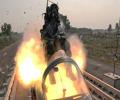
The DRDO conducted the test in collaboration with the Aeronautical Development Agency and Hindustan Aeronautics Limited.
The missile also known as Hataf VI has a range of 200 km and can carry all types of warheads, state-run PTV reported.
Though the Ghauri can hit targets deep within India, Islamabad said it was not meant as a message for New Delhi.
'This strike has certainly enhanced your image.' 'Otherwise, people would have called you a damp squib, capable of doing nothing except talking big.'

The ballistic missile launch was the first by Iran since Trump became President.

The missile, developed by the DRDO, has a range of 3,500 km and it will be able to bring almost all parts of Pakistan and several areas of China within its reach, officials said.
India on Thursday test-fired its indigenously designed and developed Advanced Air Defence missile, capable of destroying any hostile ballistic missiles at low altitude, from the Integrated Test Range off Orissa's east coast.

The indigenously developed naval version of the Prithvi short-range ballistic missile has a strike range of up to 350 km and can carry 500 kg of conventional or nuclear warhead, a Defence Research and Development Organisation official said.

The test-firing of the missile from the Abdul Kalam Island off Odisha coast came amid India's lingering border row with China.

India on Monday successfully test-fired its nuclear-capable Agni-II missile intermediate range ballistic missile, with a range of 2000 kms, from the Wheelers Island off Orissa coast.

Seconds into the test, the anti-ballistic missile deviated from its planned path and it quickly became clear that it would not hit the target.

Indian carriers are grappling with severe operational disruptions after Iran launched missile strikes on the US military base in Qatar late Monday. This led to airspace closures for long hours in parts of West Asia. Iran, Qatar, the UAE, Bahrain, and Kuwait shut down their skies following the attack, forcing airlines to cancel, divert, or delay flights through these vital corridors.

The Ababeel missile brings many Indian cities within its range.
The missile is a new version of an existing nuclear capable missile.

'The heat shield technology for re-entry vehicles was first mastered in DRDO for the Agni missile.' 'This is why the Americans were so opposed to Agni in the 1980s, unlike other missiles -- it was a re-entry vehicle.'
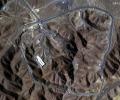
United States President Donald Trump has stated that Iran will 'never be able to rebuild' its nuclear facilities following recent American airstrikes carried out under 'Operation Midnight Hammer' over the weekend while claiming that the sites were now 'under rock', referring to Iran's nuclear facilities at Fordow, Natanz, and Esfahan.
This was the third launch of a ballistic missile in as many weeks.

As an aerospace scientist, Kalam worked with India's two major space research organisations --DRDO and ISRO.

This is the latest in a string of tests by North Korea in defiance of United Nations sanctions.
Pakistan has alleged that India was pursuing conventional, nuclear and missile development programmes which can lead to nuclearisation of the Indian Ocean and can disturb the "balance of power" in the region.

The missile has a strike range of 2000 km, the sources said soon after it blasted off from a mobile launcher at the Launch Complex-4 of the Integrated Test Range, the sources said.

Indian Navy's destroyer INS Kochi responded following the attack on the vessel, MV Andromeda Star, on April 26, officials said, adding all the crew members are safe.
Moving a step closer to completing its nuclear triad, India today successfully test fired a ballistic missile, with a strike range of around 1,500 km, from an underwater platform in Bay of Bengal. "The medium range K-5 ballistic missile was test fired successfully today from an underwater pontoon and all parameters of the test firing were met," said Defence Research and Development Organisation chief V K Saraswat from the undisclosed test area.

A Russian Parliament member claims Russia has enough nuclear submarines to counter US deployments, following statements by Donald Trump and Dmitry Medvedev.
